Water softener repair in Phoenix tends to start with one sign: the hard water is back. With the City of Phoenix 2025 report giving hardness of 10 to 17.6 grains per gallon, a softener that stops working shows as white spots and scale. This page lists the signs, the safe checks you can make yourself and what to tell a pro.
Water Treatment Phoenix is an independent referral service, not an installer, plumber or water utility. When you send the form, your details go to an independent local water treatment pro who can contact you and prepare a quote.
Signs a softener is not working
- White spots on glasses and a film on the shower glass again.
- Soap that will not lather the way it did. The USGS notes that soap reacts with calcium in hard water to form soap scum.
- Salt level in the brine tank that never goes down.
- Standing water in the brine tank, well above the salt.
- A softener that runs constantly, or never seems to regenerate.
- Salty-tasting water after regeneration.
- Low water pressure that started after the softener was installed or serviced.
- Error codes or a blank display on the control valve.
Any one of these is worth a look. Several together point to a fault in the valve, the brine system or the settings.
Safe checks before you ask
Some causes are simple. These checks need no tools and do not involve opening the valve or the plumbing.
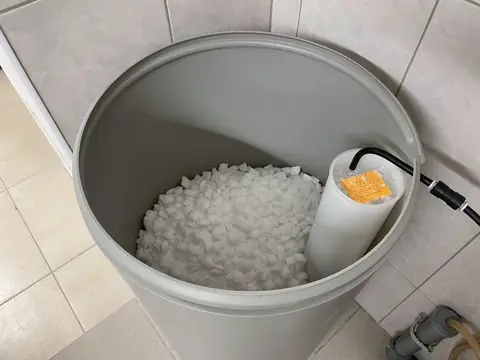
- Is there salt? Lift the brine tank lid. If the salt is gone, add it, as the maker’s guide says.
- Is the softener in bypass? Find the bypass valve on the pipes. If it was turned during other work and not turned back, the house is on hard water.
- Is the power on? Check that the control valve has power and its display looks normal. After a power cut, the maker’s guide says whether the time setting needs checking.
- Is there a salt crust? Sometimes salt forms a hard crust in the brine tank, called a bridge. If you see one, mention it to the pro.
- Has the hardness setting changed? If the valve is set lower than your water’s hardness, it regenerates too little. The city’s range runs from 10 to 17.6 grains per gallon.
If none of those explains it, stop there. The control valve, the injector and the resin are service work.


What to tell the pro
A clear description saves a wasted visit. When you send the form, or when the pro can contact you, have this ready:
- The make and model on the control valve, and its age if you know it.
- What you see: spots, salt not going down, water in the brine tank, errors.
- When it started, and anything that happened around then: a power cut, plumbing work, a move into the house.
- Whether you use sodium chloride or potassium chloride.
- Whether the house is on City of Phoenix water or another provider.
What a service visit can look at
A pro servicing a softener can test the hardness coming in and going out, check the control valve’s settings and clock, look at the brine line and injector, check the resin, and run a regeneration to see what happens. The result should be a reading of your water and a plain explanation of what failed.
| What you notice | What a pro may check |
|---|---|
| Hard water back | Hardness setting, regeneration schedule, resin, bypass |
| Salt never goes down | Salt bridge, brine line, injector, valve |
| Water standing in brine tank | Brine line, float, drain line, valve |
| Salty taste | Rinse cycle, brine draw, valve settings |
| Low pressure | Bypass, resin, valve, connections |
Softener acting up? Ask a local pro to look at it.
Repair or replace?
Sometimes a part fixes it; sometimes the softener is not worth saving. Ask the pro to explain both options with the reasons. Questions that help:
- What exactly failed, and how did you confirm it?
- Is the part available for this model?
- Is the softener sized for my hardness and household, or was it undersized from the start?
- If I replace it, is the new unit certified to NSF/ANSI 44?
- Does a replacement need a City of Phoenix permit? The city lists installing or replacing a water softener among projects that may require a permit.
If you decide to replace, read water softener installation in Phoenix for sizing and the permit.
Routine service
Should a softener be serviced even when it seems fine? Follow the maker’s schedule, keep salt in the tank and check now and then that soft water is coming out. A simple hardness test at the kitchen tap shows whether the softener is doing its job. Water utilities commonly note that some softening systems can increase corrosivity, which can damage a water heater’s anode; a service visit is a good time to ask about the settings.
Sodium and the brine
A salt-based softener adds sodium in exchange for the hardness it removes. If the water tastes salty, mention it to the pro and have the softener checked. Anyone on a sodium-restricted diet should ask a doctor, as water utilities commonly advise.
After the repair
Once the softener is running again, test the water at a kitchen tap for hardness, and keep an eye on the salt level over the following weeks. If the problem returns, tell the same pro what you see; a fault that comes back points to a different cause than the first fix found.
Why Phoenix hardness works a softener hard
A softener has to remove every grain of hardness that comes in. At 10 grains per gallon, the low end of the city’s 2025 range, every 100 gallons carries 1,000 grains. At 17.6 grains per gallon, the high end, the same 100 gallons carries 1,760. A softener sized for the lower figure, or set to it, regenerates too little for the higher one, and hard water slips through. That is why the hardness setting is one of the first things to check, and why a pro should measure the hardness at your tap rather than assume it.
What affects a repair
This site prints no prices. What a repair involves depends on what failed and on the softener itself:
- The fault: a reset clock or a salt bridge is a different job from a failed valve or worn resin.
- The model: whether parts are still made for it.
- Access: whether the softener and its bypass can be reached easily in the garage or utility area.
- The settings: a unit set for the wrong hardness can look broken and only need resetting to your water.
- The connections: leaking fittings or an old bypass may be part of the job.
Ask the pro to explain which of these applies before any work starts, and to put it on the quote.
A softener that came with the house
If you bought a home with a softener already in place, you may not know its age, its settings or whether it was ever serviced. Look for a label on the control valve with the make and model, and any service sticker. Note the hardness setting if the display shows it. That information helps a pro decide whether the unit is worth servicing or whether replacement makes more sense for the hardness of your water.
Keeping a record
After a repair, keep a note with the softener: the date, what was found, what was replaced and the hardness readings before and after. The next service visit starts from that record, and if you sell the house, the buyer knows what they are getting.
Related pages
For how a softener works and what to look for in a new one, see water softeners in Phoenix. For the city’s hardness figures and what they mean, see the Phoenix hard water guide.
How to ask for softener service
Send the form and choose “Filter or system service”. Your request goes to an independent water treatment pro in the Valley, who can contact you to talk it through and arrange a visit. Asking is free, and you are never obliged to go ahead with a repair or a replacement.
Questions people ask
Why is my softener full of water?
Standing water well above the salt can point to the brine line, the float, the drain line or the valve. A pro can check which.
Why is the salt not going down?
A salt bridge, a blocked injector or a valve that is not regenerating are causes to check. Look for a crust first.
Can I fix a softener myself?
You can check salt, bypass, power and the hardness setting. Valve, injector and resin work is service work.
Does replacing a softener need a permit in Phoenix?
The City of Phoenix lists installing or replacing a water softener among projects that may require a permit. Confirm the current rule.

Ask a local pro