Phoenix water is hard. The City of Phoenix 2025 water quality report gives total hardness of 172 to 302 ppm, or 10 to 17.6 grains per gallon, and a water softener is the system built to take that hardness out for the whole house.
Water Treatment Phoenix is an independent referral service, not an installer, plumber or water utility. When you send the form, your details go to an independent local water treatment pro who can contact you and prepare a quote.
What a water softener does
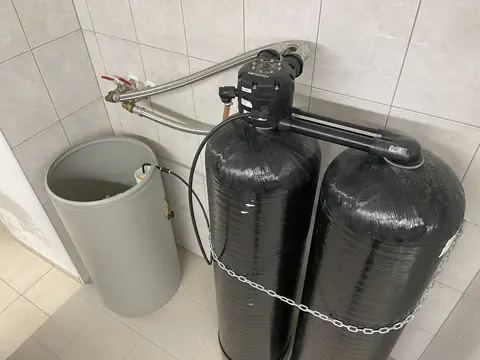
Hardness is mostly calcium and magnesium, the USGS explains. A conventional softener passes the water through a tank of resin that trades sodium for the calcium and magnesium, as Penn State Extension describes it. When the resin is spent, the softener regenerates: brine from the salt tank is flushed back through the resin. NSF/ANSI 44 is the standard for this kind of residential softener, one that uses a regenerable cation exchange resin.
The water that comes out is softened water. In hard water, the USGS notes, soap reacts with calcium to form soap scum and more soap is needed; taking the hardness out is what softening is for. The City of Phoenix report itself says hard water can cause some types of scaling in pipes and water heaters, and on plumbing fixtures.
You will also see the words water conditioner and water conditioning used for the same thing in Phoenix. The names are used loosely. Ask what a conditioner actually does: if it is an ion exchange softener, it should be certified to NSF/ANSI 44. If it is a salt-free unit, it is a different technology, and you should ask what it is certified for.
How hard is your water, exactly?
The city’s range is wide, from 10 to 17.6 grains per gallon across its system. That spread is why a softener should be sized from a reading taken at your own tap, not from a city average.
| Milligrams per liter | About grains per gallon | USGS name |
|---|---|---|
| 0 to 60 | 0 to 3.5 | Soft |
| 61 to 120 | 3.5 to 7 | Moderately hard |
| 121 to 180 | 7 to 10.5 | Hard |
| Over 180 | Over 10.5 | Very hard |
At 172 ppm, the bottom of the city’s range is hard on the USGS scale. Everything above 180 is very hard, and the top of the range, 302 ppm, is far into that band. One grain per gallon is about 17 mg/L, which is how the city’s two figures line up.
Not a Phoenix customer?
The city’s figures apply to City of Phoenix Water Services customers. If your bill comes from another provider, ask it for its annual water quality report and use its hardness figure instead.
Sizing a softener for Phoenix hardness
A softener is rated by how many grains of hardness it can remove before it needs to regenerate. The arithmetic is simple: the hardness of your water in grains per gallon, multiplied by the gallons your household uses, gives the grains the softener has to remove.
| Hardness at the tap | Grains in every 100 gallons |
|---|---|
| 10 gpg (low end of the city’s range) | 1,000 |
| 14 gpg | 1,400 |
| 17.6 gpg (high end of the city’s range) | 1,760 |
So the same house can need a noticeably bigger softener at one end of Phoenix’s range than at the other. A pro sizing a system should ask how many people live in the house, look at your water use, and set the softener to the hardness measured at your tap. Ask to see that figure written on the quote.
- A hardness reading at your tap, in grains per gallon.
- The household’s water use, from the people in the house or from your water bill.
- The softener’s capacity in grains and how often it will regenerate at that use.
- The valve type and how it decides when to regenerate.
- The standard it is certified to: NSF/ANSI 44 for an ion exchange softener.


Salt, potassium and sodium
A salt-based softener adds sodium in exchange for the hardness it removes. Water utilities commonly advise anyone on a sodium-restricted diet to consult a physician before relying on softened water. Some owners ask about potassium chloride in place of sodium chloride. Ask the pro whether your unit can use it, and ask your doctor about your diet.
You can ask for one tap to be left unsoftened for drinking, or add reverse osmosis at the kitchen sink. Both are choices to talk through with the installer.
Salt-free systems
Salt-free units are sold in Phoenix too. They are a different technology from ion exchange, and they are not the kind of softener NSF/ANSI 44 describes. Before you buy one, ask what it is certified to do and against which standard. The salt-free water softener guide lists the questions to ask.
What best means for Phoenix water
People search for the best water softener in Phoenix, and the honest answer is the one that fits your water and your house. This site names no brand and no installer. A system is a good fit when it is sized to the hardness at your tap, certified to NSF/ANSI 44, set up so you can reach the salt tank easily, and installed with any permit the city requires.
- Certified: look up the model’s certification yourself rather than relying on a sticker or a sales sheet.
- Sized: the capacity matches your hardness and your use, written on the quote.
- Serviceable: you know where the bypass is, how to add salt and who to contact if hard water comes back.
- Permitted: the City of Phoenix lists installing or replacing a water softener among remodeling projects that may require a permit. The sheet is from 2020, so ask the installer to confirm the current rule.
The basic advice on home treatment holds anywhere: choose a unit certified by NSF, Underwriters Laboratories or the Water Quality Association for what you want to remove. The City of Phoenix report also points readers to the Water Quality Association, wqa.org.
Want a softener quote for your Phoenix home?
Softener, filter or both?
A softener is not built for taste or odor. If your complaint is a taste in every tap, look at water filtration in Phoenix. If you want drinking water with fewer dissolved solids, look at reverse osmosis. For the whole picture of a softener on the main line, see whole-house water softeners.
The water heater
The City of Phoenix report says hard water can cause scaling in water heaters. Water utilities commonly add a caution worth knowing: some softening systems can increase the corrosivity of the water, which can damage the anode in a water heater. Ask the pro how the softener will be set and when the water heater’s anode should be checked.
When you already have a softener
If your house came with a softener and white spots are back, the salt level never drops, or the brine tank holds standing water, the unit may need service rather than replacement. Softener repair and service explains what to check and what to tell a pro. If you are replacing it, softener installation covers the permit, the connections and the questions for the quote.
Signs your home could use a softener
The EPA’s private well guidance lists the signs plainly: scaly deposits and soap that will not lather point to hardness, and a softener is the treatment it names. In a Phoenix home on city water you may notice:
- White crust around faucets, showerheads and the base of fixtures.
- Spots and a cloudy film on glasses and dishes.
- Soap scum on the tub and shower glass, and soap that takes more to lather.
- Scale inside a kettle or on the elements of appliances that heat water.
None of these is a health problem. They are the cost of hard water in time, soap and cleaning, and they are the reason softening is a choice rather than a requirement.
How to ask for a quote here
Use the form on this page: your name, phone, ZIP code and what you notice. Your request goes to an independent water treatment pro in the Valley, who can contact you, test your water and prepare a quote. Asking is free and you are never obliged to go ahead. For the figures behind this page, read the Phoenix hard water guide.
Questions people ask
Is softened water better for your health than hard water?
No health claim can be made either way. The City of Phoenix report says taste, odor and hardness are not regulated under drinking water health standards. Softening is about scale and soap. If you watch your sodium, ask your doctor.
What is the difference between a water conditioner and a water softener?
The names are used loosely. Ask what the unit does: an ion exchange softener should be certified to NSF/ANSI 44. A salt-free conditioner is a different technology, so ask what it is certified for.
How hard is Phoenix water in grains?
The City of Phoenix 2025 report gives 10 to 17.6 grains per gallon, or 172 to 302 ppm.
Do I need a permit for a softener in Phoenix?
The City of Phoenix lists installing or replacing a water softener among remodeling projects that may require a permit. Ask the installer to confirm the current rule.
How often does a softener need salt?
It depends on the hardness, the water you use and the softener’s settings. Follow the maker’s guidance and check the brine tank regularly.

Ask a local pro